 Jewish tradition has a very strong emphasis on "girsa d'yankusa" - the things you learn when you're young. On a fresh, impressionable mind, things make a much greater impact - so it's considered really important to start out on the right foot.
I can see how true this is of myself. I grew up in a pretty liberal household in South Africa, and the things I learned under my parents' tutelage have been the things that have most stuck with me in my life. Things like basic menschkeit and honesty. Having an open mind, and encouraging questioning. A deep seated revulsion at racism of any sort - I will never forget the telling off I got when, as a 6-year-old, I repeated a racist term I had learned from my schoolmates! I also imbibed a culture of activism, and having the courage to stand up for what you believe in, especially from my mother, who was arrested several times for anti-apartheid activities. People who haven't lived in a fear society usually don't fully appreciate just what kind of mesirus nefesh it takes to be a dissident, and actively work against the regime. My parents took great risks to do what they believed was right, and I can only pray that I can be a worthy heir to this spirit.
 I only became religious at age 20, long past my "girsa d'yankusa" stage. And while I have intellectually accepted the ol malchus shamayim, internalizing it to the degree that it is a part of my personality is much more of a struggle, particularly where my religion might conflict with some of the things I learned as a child. I instinctively look for accommodations, and it's a constant challenge for me to be conscious of where the accommodation is justified, and where it's just a case of cognitive dissonance.
For example, I learned to live and let live. If someone else wants to do something that you disapprove of, unless it materially affects you, you should leave him alone to make his own choices. Judaism, on the other hand, is pretty strong about coercion, to the point where (in the presence of an authorized court) a Jew who eats pork can be flogged to within an inch of his life, and he can be sentenced to death for driving his car on shabbos. If that's not coercion, I don't know what is. But here I am, openly criticizing the ban on pork sales, advocating for civil marriage legislation, and quite willing to give directions to a Jew who is driving his car on shabbos. In each one of these instances I have, I believe, sound halachic reasons to back up my position, whether because the benefit of the coercion is outweighed by the loss, or because by giving the guy directions you are actually minimizing the chillul shabbos. But my position is not mainstream; I venture you'd find that most religious Jews would reflexively take exactly the opposite position to me in all of the above issues.
I was brought up with democracy as a fundamental value. People choose their leaders, and the leaders are answerable to their electorate, who will punish them if they fail to perform. Contrast Judaism, which on the face of things, does not have such a concept as leaders elected from the bottom up. The Jewish ideal is top-down: a king, appointed by Divine edict through a prophet, succeeded by his biological heirs, and wielding practically absolute power, albeit constrained by his own requirement to keep all the mitzvos of the Torah, as well as certain checks and balances that are under the control of the Sanhedrin. And the Sanhedrin itself is certainly not elected; it is appointed in much the same way (lehavdil elef havdolos) as the Israeli Supreme Court, only more so - there is not even a judicial selection committee for lay people to have their say; new dayanim on the Sanhedrin are appointed only by the existing members!
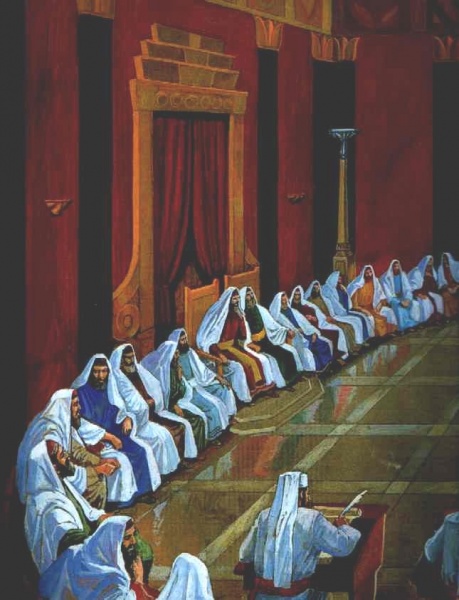 I reconcile this by saying that the Sanhedrin represented an unbroken chain of command from Moshe Rabbeinu and the 70 elders, who in turn appointed the best possible people to fill any vacancies. If you have a benevolent leadership like this, their judgment is probably way better than the judgment of a bunch of mostly ignorant lay people. After all, according to pure democratic principles, we have the absurd situation that a mentally retarded teenager's randomly chosen vote carries as much weight as the carefully considered position of a G-d fearing genius like Prof. Yisrael Aumann. But in our time, when we have no prophet to declare whom Hashem has chosen as king, and our Rabbinic chain of command has been all but broken, democracy is simply the best alternative we have left. We cannot continue to follow the paradigm of self-appointed, self-perpetuating structures, because look what happens if your original kernel is corrupt: you come out with an abomination like the Israeli Supreme Court, whose primary agenda appears to be stripping Israel of every last vestige of real Jewish values. We are therefore forced to fall back on the people's choice, both in terms of leadership and judiciary, because a leadership that is answerable to its people is far more likely to be benevolent than an unscrupulous dictatorship. (I include the judiciary in a guarded kind of way, because truthfully, we do have a Jewish judiciary even today - but there is no one beis din that is universally accepted by all factions, so unless all today's gedolei Torah can get together to appoint a Sanhedrin, a hypothetical Torah-true State of Israel would have no alternative but to have some kind of democratically appointed Sanhedrin, perhaps appointed by democratic vote among the gedolei hador.)
What about other clashes with Western values, such as "gender equality"? Yeah, yeah, I know all the apologetics about "separate but equal", and the different roles that men and women are supposed to play in Judaism. But am I happy to let my two sons split my entire inheritance, leaving my three daughters with nothing? Not a chance. Whatever the halachic devices are to do so, I fully intend to make sure that my daughters get their fair share of my estate. What is this? - do I think I'm smarter than the Torah? I'm uncomfortable with the dissonance between my professed beliefs and the fact that I simply don't want my inheritance to be distributed the way the Torah says it should be. Is that a bad thing?
I'm sure there are many other areas of my life where my worldview is colored by my secular/traditional upbringing, and is in conflict with authentic Jewish values - whatever those are.
What about you?
What was the "theme" of your upbringing?
How does that mesh with your current lifestyle?
What dissonances do you experience in your life?
What lessons have you learned, and what advice do you have for others to deal with dissonances?


