Showing posts with label Judaism. Show all posts

Tuesday, April 2, 2019

Election fun!

Seven talking points about the election on April 9

A lot of people are talking about how disillusioned they are about next week's general election in Israel, how no party really deserves their vote, and how bad and dangerous certain candidates or parties are. I have a different take on things that is a lot more upbeat. Here are seven talking points for your consideration.

1. The polls are (mostly) rubbish

One of the best things that has come out of this election is the legal ruling obtained by the Green Leaf Party early in the campaign, requiring (among other things) that polling companies release their raw data, not just their final calculations. While most of the media doesn't report on the raw data anyway, it's available, and extremely interesting. 

For example, I present you with Exhibit A, the raw data from a Channel 13 poll taken on 28 March:
The leftmost column is the percentage of respondents who chose the selected option; the middle column is the number of seats they are allocated, based on their raw data. Loosely. Very loosely.

The first thing I will draw your attention to is the contrast between the results of UTJ and the New Right. In the raw data, UTJ scored 3.8%, while NR got 3.7%: a virtual dead heat. Yet in the allocation of seats, UTJ gets 7, while NR gets only 5! Now, this is not necessarily gross misrepresentation; after all, UTJ supporters are particularly difficult to poll, since very many of them do not use the Internet, and do not have SMS-capable phones, so it is probably correct to bump their numbers up somewhat. But how much? That's a question for the judgement of the pollsters.

Where it gets a little more dodgy is how Likud (21.6%) and Blue & White (25.5%) both ended up with exactly 30 seats. Or how Zehut (7.5%) and Labour (7.8%) were allocated 7 and 10 seats respectively. I suspect the pollsters are taking the 9.1% of "Undecideds" and allocating them to other parties according to their best judgement. Or according to their own political preferences. Or according to groupthink. Whatever. Whether the data manipulation is innocent or nefarious, it's pretty clear that polling is not an exact science. Expect results that are nowhere near the conventional wisdom.

2. The media hype about the Left/Right blocs is utter rubbish

Cartoon: Philip Whisenhunt, The Commonwealth Times
Every poll gets trumpeted in the media as a scorecard of how many seats are in the "Right" bloc, and how many are in the "Center-Left" bloc. So, for instance, the above poll would be announced as "Right bloc leads 64-56". If they're feeling really adventurous, they might call Zehut the "balance of power", since its leader, Moshe Feiglin, has said he has no preference between Binyamin Netanyahu or Benny Gantz for Prime Minister, claiming that the score is "Right 57-56 Center-Left", with Zehut being the kingmakers. Sounds really close and competitive, right?

Well, it's all utter rubbish, because they are ignoring the fact that the Arab parties are less concerned about serving their constituency than about grandstanding against anything and everything the government does, and will never join any coalition, whether "Right" or "Center-Left". This is a great pity; I've said often that it would be really cool if a right-wing government could co-opt at least one Arab party into the coalition with some harmless portfolio like Minister of Welfare. But it isn't happening any time soon, at least not with the current crop of Arab politicians, so those 11 seats in the poll above are spoilers, and cannot be counted in any "bloc", other than their own. So why does the media keep harping on with this ridiculous scorecard? Because it keeps things exciting; it sounds so much more like a cliffhanger than if they had to tell the truth, which is "Right 64-45 Center-Left".

3. There are no (really) bad scenarios

Photo credit: JPost
I don't believe in trash-talking, not even directed against politicians, and I'm not going to start now. Fortunately, I don't feel much temptation to do so, either. I have friends who support almost every one of the major parties, and I have not attempted to persuade them otherwise, because all the party lists contain some excellent people, who really love Israel, and sincerely want to do their best for the country. They also have a lot of candidates I don't like, but it's unrealistic to expect to like every single candidate on your party list. I may disagree with their approach, but who's to say I know better than them? At the very least, I don't see anyone on the map who both (a) has an agenda that I believe will be seriously detrimental to Israel, and (b) will likely have the power to implement that agenda. The most serious concern I have is that the Blue-and-White party might install a trade union boss as finance minister, but I don't see that as a realistic scenario. As mentioned above, it seems to me that Netanyahu is a shoo-in to form the next government, but if it happens to be Gantz, I'm not too concerned; he would almost certainly have to rely on Feiglin to make his coalition, and Feiglin's price will include the Finance Ministry. Having Feiglin in the government also assuages any concerns I might have that a Gantz-led government would do anything too reckless on the diplomatic front. So, barring some kind of black swan event, I'm pretty relaxed about whatever outcome this election yields.

4. Zehut is a game-changer

That brings me to Feiglin and Zehut. Without getting into arguments for or against any aspect of their platform, I think it's fair to say that Zehut's entry into Israeli politics is a massive game-changer. Firstly, the fact that they even have a manifesto is, amazingly enough, unprecedented. Every other political party only has a list of personalities; you vote for the people and hope they do in office what they intimated they might do while they were campaigning. Zehut has a 344-page platform, spelling out exactly what policies they have committed themselves to. We'll see how good they are about following through on their commitments once they're in office, but one way or another, I hope more parties do the same in future, rather than asking us to close our eyes and open our mouths.

Just one of hundreds of Zehut memes
Secondly, Zehut has whipped up both support and opposition to levels of near-hysteria. You can't post a kitten video on Facebook, without some Zehutnik friend of yours commenting about how life will be better for cats once Zehut runs the country, see page 271 of the platform #מצביע_זהות. To which your Meretz friend responds, calling the Zehut friend a messianic fanatic who wants to build the Third Temple. Then a United Right friend accuses him of being a pothead who wants to destroy Judaism in Israel, followed by a Likudnik berating Feiglin for his anticipated betrayal of the Right, while a Blue & White supporter says Zehut is a dangerous cabal of extreme Rightists who will bring the apocalypse down on our heads. Seriously. Somehow, Zehut has stirred up the pot so much, that literally every other political party feels threatened by them, and the accusations against them are diametrically opposite, depending from direction they originate. That itself speaks volumes. Plus, it's hugely entertaining.

Thirdly, no party before has gone so hard for the jugular in terms of their libertarian agenda to root out the ugly vestiges of socialism in Israel. They are aiming for the Finance Ministry, and there is good reason to believe they will get it. And from there, I am very optimistic that they will liberalize the economy, removing the protectionism, tariffs, and other obstacles to the individual's economic success. Bring it on.

To the people who are worried about Zehut's proposed solution to the Palestinian issue, I get that concern. But, much like Blue & White's union boss is unlikely to become finance minister, I don't see Zehut dictating foreign or security policy any time soon, and they haven't prioritized those issues on their agenda. They're going for finance and education, and in both of those fields, I think they will be an excellent force for good.

5. There is life after Netanyahu

Credit: Wikimedia Commons
The election has been complicated by the legal cloud hanging over Netanyahu's head, though that doesn't seem to have affected his likelihood of reelection much. Nonetheless, the indictment against him carries some serious weight. Noah Roth posted an excellent and balanced analysis of the case here, and its really worth reading. 

The bottom line is that even after winning the election, Netanyahu could well be forced out of office. And if he is, the next prime minister will likely be determined by primary elections within the Likud. Are you a Likud member? If so, you may be treated to the privilege of directly electing the next leader of Israel. And despite the fact that many first time voters don't even remember a time when Israel had a prime minister not called Binyamin Netanyahu, everything will be OK. There are a lot of very good and highly qualified candidates in the Likud, and even some who speak English as well as Bibi. Netanyahu has been a very good prime minister, in my opinion, but even without his legal issues, he should have been term-limited. It's not good to have the same person in power for too long, and some fresh leadership might be nice.

6. Not much else will change

As mentioned above, Zehut's likely takeover of the Finance Ministry has potential to make some big impact on the economy. Plus, they've made cannabis legalization a sine qua non condition of entry into any coalition, and nobody is really that strongly against it, so I think it's safe to say we'll soon see pot on sale in pharmacies within the next year.

Other than that, I don't see many other policy initiatives making much headway. The Charedi parties will likely be indispensable to any coalition, so I cannot foresee any major changes to the status quo as far as social or religious legislation is concerned. The Likud will remain in control of security and foreign policy, so expect more of the same there. Ayelet Shaked is banging war drums against the High Court, but I don't foresee her achieving much more of a judicial revolution in her next term of office than she did in the first one. 

The really big unknown factor, of course, will be the unveiling of Trump's Middle East Peace Plan. I have no idea what's in it. Those who do know, aren't saying, and those who say, don't know. But that's one thing that has the potential to set the cat among the pigeons.

7. Relax, everything will be fine!

Credit: Chabad.org
This election is characterized by the fact that there aren't really any probable nightmare scenarios, which hasn't always been the case in past elections. Most of the candidates are actually pretty decent, and whatever happens, things will be fine.

It's not worth getting into heated debates on social media. Our relationships with our friends and neighbors will continue past April 9; it's really not worth burning them over one or two votes here or there.

Shalom al Yisrael!

Saturday, December 13, 2014

My Election Challenge

A few days ago a friend of mine remarked to me how much he hates elections.  "We're going to have three solid months of sin'as chinam now," he lamented.  I have been reflecting on his words, and thinking, does it really have to be this way?

A few months ago, the whole of Israel was united as one for 18 days, while we searched and prayed for Eyal, Gilad and Naftali.  כאיש אחד בלב אחד - like one person with one heart.  It didn't matter if you were secular, Dati Leumi or Charedi, left-wing or right-wing.  And we were all broken hearted together when the terrible news became known.

Why should it be that we can only be united when we are faced with crisis and tragedy?  Why should we shatter that unity just because we are choosing a new government?

Think positive - Talk positive - Be positive
Let's fantasize for a few minutes.  Imagine that for the next three months of electoral campaigning, all parties and candidates would present themselves with compelling and positive arguments why you should vote for them, without demonizing, excoriating, ridiculing, lambasting or even criticizing their competitors.  Imagine complete mutual respect between all political parties, and everyone being particular to disagree about issues, and never descending to ad hominem attacks, let alone smearing entire communities.  Imagine if all of us armchair political commentators, on blogs, Facebook and talkbacks, would hold ourselves to this standard of always writing respectfully and gracefully, really trying to understand the other person.  And where we must disagree, then agree to disagree - and yet always treat the other as befits a tzelem Elokim, someone created in the image of God.

את חטאי אני מזכיר היום; I confess I have been guilty of publicly besmirching political figures in the past.  I therefore wish to apologize in the same forum for my past transgressions.  I am sorry for speaking loshon hora and adding fuel to the fire of baseless hatred.  And I undertake to change my ways.  Any time I feel the need to post something, I will keep my contributions as much as possible to the positive presentation of good ideas, and if I feel the need to criticize something, I will weigh up if it is really necessary and beneficial to air my views in public, and if it is, I will confine myself only to arguing about the issues, and never attacking the person.

I hope you will join me in this.  The satan is already rubbing his proverbial hands in glee, in anticipation of all the division and hatred that usually accompanies election season.  For every person who is able to overcome their nature and restrain themselves from saying or writing things that will increase machlokes, but rather relates to people with whom they disagree with honor and respect, we will surely increase the merits of Am Yisrael.  And who knows?  Maybe our reward will be a that we get a stable, functional government whose leaders and ministers will likewise care for the needs of all sectors of the population.  That idea sounds almost like Messianic times, doesn't it?


Thursday, April 24, 2014

True story: The Gabbai Tzedaka and the Loan Shark

This is a remarkable true story, which I have shared at many a shabbos table and other forums over the past year or so.  Based on the reactions I've had, I decided to put it on my blog, so that it can be shared by the world at large, rather than being restricted to those social gatherings with low enough standards to both admit me and grant me speaking time.


Chabad in Pahar Ganj, Delhi
On one of my business trips to Delhi, India, around a year ago, I was required to stay over for shabbos, where I was most grateful to be able to take advantage of the hospitality of the local Chabad.  There were around 50 guests at shabbos supper, almost exclusively Israeli post-army backpackers.  By my reckoning there were only maybe 2 or 3 other people over the age of 25.  One of those was AY, a thoughtful, softly-spoken fellow of about 50.  I asked him if he was also here on business, and he said no, he's just here to clear his head and have some time off.

Later that evening AY was invited to give a d'var Torah.  This is the story he told (in Hebrew), to which I hope I have done justice in English here, both factual and literary.
I live in the Golan Heights.  Among other things I do, I serve the community as a gabbai tzedaka (one who collects and distributes funds for the needy).  We have a system in the Golan: most of the time each community looks after its own, but sometimes there's a case of extreme need, when all the communities will band together in order to help someone.
A few weeks ago, I got called into one such emergency meeting of all the Golan community gabbaei tzedaka.  There was a fellow - we'll call him Reuven - who had gotten into some hard times.  Having exhausted his credit line at the bank, he went and borrowed on the black market, from a loan shark by the name of Mordechai G.  Borrowing on the black market is a pretty poor situation to be in, because not only do they charge horrifying interest rates, tens of times higher than the banks, but if you don't pay them back, let's just say that they don't bother seeking court judgments against you.  Anyway, Reuven had borrowed a large amount of money for a business deal that went sour.  When he could not pay back what he owed, he started finding his car tires slashed and his house windows broken - but he refused to beg for charity... until one day the loan shark's goons intercepted his kids on the way home from school and roughed them up.  At this point he came for help, by which stage his debt had compounded to 1.5 million shekels.
Now, that is a pretty staggering amount.  We did our best, and made an emergency appeal throughout the Golan communities.  People really did dig deep.  I'm proud to say that within a matter of days we had raised a quarter of a million shekels, which is truly a remarkable achievement.  But still, only one sixth of the required amount.  We gabbaim met again, and decided that our only hope was to request a meeting with the loan shark, Mordechai G. himself.  So it was that one morning we gathered together a respectable delegation of 5 people, including some senior community Rabbonim and myself, and drove down to a hotel in Tverya, where Mordechai G. had agreed to meet us.
When we entered, it was like a scene from a bad gangster movie.  Mordechai G., a hefty man with a most intimidating glare, was sitting on a couch behind a coffee table, with two goons standing behind, flanking him with their arms folded.  I would have laughed if their presence hadn't been so terrifying.  He motioned for us to sit.  After we did so, the senior Rav spoke up:
"Thank you for agreeing to meet with us.  As you know, we're here about the matter of Reuven and the 1.5 million shekels he owes you... we have done our best, and the community has really pulled together for him... we have managed to raise 250,000 shekels to cover his debts.  We hope that you can understand the difficulty of repaying such a large amount, and perhaps, out of the goodness of your heart, you might consider easing his terms, or maybe-"
And suddenly, in the middle of the Rav's sentence, Mordechai G. sprang to his feet, flipped the table upside down and smashed it on the floor.
"I WANT THE MONEY!" he snarled. 
We were all frozen.  Nobody knew what to do or say.  And then, before I knew what I was doing, I spoke up.
"OK, I'll get you your money."
He looked at me angrily.  "What are you talking about?  Just a minute ago you told me you didn't have the money!  Now you say you do!  Don't mess me around!"
"Come and talk to me privately," I said.  "If you like what I've got to say, then great.  And if not, you're no worse off than you are now."
He contemplated this suspiciously for a few seconds, then nodded agreement, and started leading me towards an adjoining room.  I honestly had absolutely no idea what I was going to say; all I could do in those 15 seconds as we were walking was daven that Hashem would put some idea into my head and the right words in my mouth.
So we got into the next room and closed the door.  He turned to scowl at me, his thumbs tucked into his belt.  "Nu?"
Baruch Hashem, I found something to say.  "Firstly, I want you to understand that the five of us who came here today, did not come here because we're making any money on this deal.  On the contrary, it's costing us all in time and resources.  We're all working men and we have plenty of other responsibilities.  But we decided to spend our morning coming to meet you.  Why?  Because it's a mitzvah - a mitzvah of pidyon shevuyim (redeeming a hostage) - and for a mitzvah like this, we believe we will receive an eternal reward in the Next World that is worth infinitely more than any money in this world.  So here's the deal I'm offering you: firstly, we'll give you all the money we brought with us: 250,000 shekels.  Then, on top of that, I can't make any offers on behalf of my companions, but I'll offer you my own reward in the Next World for the fulfillment of this mitzva, if you will forgive the rest of the debt."
Mordechai G. was now looking at me as if I had just climbed out of an alien space ship.  He stood there in silence for a few seconds, and I was starting to wonder if he was sizing up how he was going to dispose of my body.  Then, suddenly his face relaxed, he pulled his right hand out of his belt and stuck it out at me.
"It's a deal," he said, grasping my hand.  I was in total shock as we shook.  "But -" he added, gripping my hand more firmly, and pointing his left index finger threateningly at me, "you may never tell anyone else about our deal.  Because if word gets out that Mordechai G. forgave a loan, my business is finished."
"You have my word," I promised.  And so we left the room and announced to all present that the debt had been settled, and there would be no further need of discussion.  My companions were gobsmacked.  All the way home they pressed me, and all I could tell them was that I could not tell them.  And so I thought that forever I would carry this secret around in my heart, never able to tell anyone.
The next day, I again had cause to drive down to the Kinneret.  Driving along the road that skirts the shores of the lake, I saw up ahead the flashing lights of a number of emergency vehicles stopped on the side.  I pulled over to see if there was anything I could do to help.  There was a young policeman, very agitated, who told me what had just happened.
He had been doing routine checks on passing cars, pulling them over, checking their licenses, etc.  He pulled over one car, in which the driver - the only occupant - was not wearing his seat belt.  "I'm sorry, sir, but that's a 400 shekel fine for not wearing your seatbelt."  The driver flapped his hand at him contemptuously.  "Pah!  So give me four.  I don't care; that kind of money is nothing to me.  I am Mordechai G., and I drive without a seatbelt."  So the policeman gave him a ticket, which he tossed onto the passenger seat; so doing, he slammed the car back into gear, flattened his foot on the accelerator, took off like a rocket... lost control of the car and slammed into a nearby tree.  He was declared dead by the paramedics on the scene.
So, now that Mordechai G. is no more, I am released from my promise, and this is why I am telling you this story today.  I still don't know what to make of it; there is so much to think about, and I will leave the interpretation to you. 
I've had a year to think about it, and I've taken a few messages from AY's story.  What do you think?


Thursday, October 17, 2013

Two Beit Shemeshes, not on speaking terms

Municipal elections are less than a week away.  For me, they can't be over soon enough.

There have not been, to the best of my knowledge, any truly scientific polls to indicate who will be crowned the Mayor of Beit Shemesh come next Wednesday.  All we know is, it's close.  And we know one other thing: whoever wins Tuesday's election, around half of the city will be jubilant and throwing street parties, and the other half utterly dejected, bitter and resentful.

The thing that has characterized this election campaign the most has been the polarization, the rift in our community, the anger, the hatred, even violence.  From both sides.  And I say that not just to seem even-handed - I've seen and heard people arguing for and against both Eli Cohen and Moshe Abutbul, with fury and venom like I have never seen in them before.  Laws of loshon hora, rechilus, motzi shem ra, nezikin - even Shemiras Shabbos - out the window!   And there is almost nobody in the "undecided" category.  I've never seen anything like this before: nearly everyone I know is vociferously and unswervingly committed to their candidate.  I have not yet had a conversation with anyone who was wavering between the two!  I've witnessed way too many heated exchanges between the two camps, and not one case of anyone changing their mind.  Perhaps the undecideds are afraid to let themselves be known, lest they be set upon by one or the other faction... but I don't know, because they're not saying, and I don't even know if they exist.

This schism in our town truly breaks my heart.  In the end, we're all going to carry on with our lives, and we're going to have to live with our friends and neighbors who voted for the other guy.

Casting my mind back 5 years ago to the previous election, it wasn't like this.  Sure, there was plenty of electoral tension, but it wasn't about Haredim versus Everybody Else.  Moshe Abutbul had plenty backing from secular and traditional parties and communities, which is why he won the election.  And Shalom Lerner was backed by the faction of UTJ that is now the "Koach" party.  When Abutbul won, sure Lerner's supporters were upset, but not so grievously that they contemplated moving out of the city.

What happened?  How is it that in the space of 5 years, our city has fractured neatly down the line: Haredim (with the notable exception of the Tov party) are solidly behind Abutbul, while everyone else is voting Cohen?  It's an important question to ask, because this in itself is probably the most burning issue concerning Beit Shemesh: the relationship between the various sectors of the population.

I was having a discussion recently with an Abutbul supporter, who was earnestly rattling off an impressive list of the achievements over the last 5 years, that benefited everyone, not just Haredim, and he was getting immensely frustrated that people just refused to see the truth of the situation.  I guess he didn't learn Stephen Covey's 5th Habit: Seek to understand, then to be understood.  Did you every ask yourself why, despite everything you've said, the city has split into two practically warring factions?  If you're going to claim that the opening of a bowling alley (a private business initiative) is to the credit of the mayor, then you're also going to have to "credit" the mayor with bringing the relationships between Haredim and Everyone Else to the nadir they are at now: where anti-Cohen ads use Holocaust imagery (implicitly calling Cohen a Nazi), and non-Haredim are openly talking about leaving the city if Abutbul is re-elected.

He answered me: it's just fear.  I wholeheartedly agree.  And I think the same is true for the other side.  The shrill tenor of this whole campaign is because both sides are driven by a wild, visceral fear that the other guy might win and destroy everything for "us" (whoever "we" might be).  But it's not a full equivalence.  The Haredi camp is afraid of Cohen, because he's unknown, is alleged to have connections with the Great Satan (Yair Lapid) and the Little Satan (Naftali Bennett), and he's threatening the benign reign of their patron Moshe Abutbul.  The non-Haredi camp is afraid of Abutbul, because he's known, and whatever explanation you may proffer, they have seen him in action for the past 5 years, and they emphatically do not want a repeat performance.  Do you really want to understand why every non-Haredi party, plus Tov, quit the coalition?  Ask them!  Do you really want to understand why almost every non-Haredi voter who voted Abutbul 5 years ago, is now dreading the prospect that he might be re-elected?  Ask them!

I am certain that Moshe Abutbul is a very good man, and he is totally dedicated to doing the best he can.  But whether intentionally or not, his tenure as mayor has been exceptionally divisive, and bred extremism and hatred between different sectors of the Jewish people.  The results are undeniable: we are a city of two factions, not on speaking terms - and that is the greatest tragedy imaginable.  The fact that this happened on his watch is a gross failure, an offence warranting dismissal.  However much he may have done on paper, whatever endorsements he may bring, whoever tells me "Daas Torah", and however much of a good, sweet and kind person he may be, I cannot vote for Moshe Abutbul.

Many of my friends and neighbors have come to me gushing with effusive praise for Eli Cohen.  He sounds like a good guy, though his marketing is appalling.  I wish I could share their enthusiasm for him, but I don't.  But I will give him my vote on Tuesday, because the only thing I am sure of is that Beit Shemesh needs a new mayor, just to give us some chance of healing.

Perhaps, like me, you are disillusioned and distressed by the tsunami of sin'as chinam that has engulfed our beautiful city, and know that it cannot be allowed to continue in this path - but for whatever reason you cannot bring yourself to vote for Eli Cohen.  I can understand that.  But then, please, don't actively lend a hand to deepening the rift in our society.  Don't vote.  Or vote with a "white slip".  Make that your protest.

And even if you do vote for Abutbul, I still love you, and I'll still be your loyal friend and neighbor.


Saturday, June 29, 2013

The "Nice Guy" Trap

A week or two ago, I posted a comment on Facebook, tangentially hinting at my disapproval of the concept of State-recognized homosexual marriages.  And wow, did I get it in the neck from my friends!  I was not too surprised by the accusations of insensitivity and bigotry from my secular friends; after all, once you have removed God from the picture, there is no reason on Man’s earth why two consenting adults shouldn’t do whatever the heck they want together, and if the majority of the society they’re in feels it’s OK, then why not?  For that matter, consensual wife-swapping shouldn’t be a problem, either.  And why stop at adults?  Who says children who have reached puberty can’t decide for themselves what to do with their bodies?  And while we’re going down this route, let’s say some nutter gets hooked up with a consenting chimpanzee, and feels it’s a meaningful relationship, why should anyone else intrude?  It’s not as if it’s infringing on anyone else’s rights, is it?  Nothing to discuss here.

What perplexed me more about the reactions was the fact that so many of my religiously observant friends also jumped down my throat, giving me technical arguments like, “There’s no Torah prohibition against two men living together, so what’s the problem?” or “Keeping homosexuality illegal is not going to decrease the amount of homosexuality in the world.”  And there’s me left shaking my head.  Yes, these arguments may be technically accurate.  But for Heaven’s sake – look at the big picture!  Do these people, who profess to believe in God and the laws of the Torah, actually want our society to be moving in a direction of ever-greater licentiousness and open denigration and mockery of the moral codes that they supposedly support?  What is it that drives them to criticize me for simply stating a position that is clearly and unequivocally advocated by the Torah?

Soon after that, I was drawn into argument with a dear friend of mine who is passionately pro-Israel and very active in Israel advocacy on the Internet – yet he found it necessary to condemn the Israeli government publicly for not declaring that “price tag” vandalism should be classified as terrorism.  I took him to task on that, asking him if he really felt that writing obnoxious and threatening graffiti, terrible though that is, is morally equivalent to blowing up a bus.  We got into plenty of further discussion, but he would not climb down, and to my knowledge, his public position is still unchanged.

This got me thinking even more.  What other examples can I think of, of people taking public positions that run contrary to their stated ideology?  It didn’t take me long to draw up a short list:

  • People who deeply care about Israel’s future, advocating unilateral surrender of Israeli territory to a sworn enemy that has never once given any indication that it will make peace with us – and this, “for the sake of Israel’s long-term security”.  Come again?
  • People who are very concerned about security and the threat of global terrorism, yet willfully refuse to identify the perpetrators or their ideology.  (Hint: begins with “I”, ends with “-slam”.)  Result: ridiculous security checks at airports that treat a 69-year old granny with the same level of suspicion as a 23 year old Middle Eastern male wearing a bulky trenchcoat in midsummer.
  • People who profess a strong belief in liberalism and human rights, and will campaign vociferously for more and more social freedoms, but who are strangely silent when in their own European hometowns, even non-Muslim women feel much safer to go outside wearing headscarves.
  • The reluctance of the Republican Party in the USA to put forward a presidential candidate with clear and unequivocal socially conservative positions (e.g. on gay marriage, abortion), despite the conservative views of their membership.
What is it that makes people act this self-denigrating way?

On reflection, I identified exactly the same tendency in myself.  As one who was raised in a liberal, traditional Jewish home, I still have a strong connection with the circles in which I grew up, both family and friends, and I have a deep seated desire to be liked, and not to appear in the eyes of that liberal society as a knuckle-draggin’, bible-thumpin’, goggle-eyed retrograde wacko.  I have caught myself many times, in conversations with my less religious friends and family, actively introducing topics of Jewish religious extremists, just so that I can make it clear that I’m not one of them – or equivocating about some not-so politically correct Jewish laws, trying to find some sugar-coating to make them more palatable.  Bottom line, it’s insecurity in my own position.  And this insecurity, this desire to seem like a nice guy, has led me to compromise my own integrity, such as speaking loshon hora or denigrating Jewish laws and traditions.

What's more, being ingratiating gains nothing in terms of my own goals.  When I am cringing and apologetic for my views, I project that insecurity clearly, so whoever sees it realizes that I am pliable and unconvincing.  In real terms that may mean I find myself pushed into areas of compromising my own religious observances.  It means that Israel's political concessions are pocketed, unreciprocated, and the demands for further surrenders are simply scaled up.  When a pro-Zionist is quoted as criticizing the Israeli government, the anti-Zionists will eagerly quote him to prove that "Even your own supporters think you're immoral."  And so on.

We'd love to believe otherwise, that we humans really are all friends with just a few differences between us, so we compromise in the expectation that our concessions will be appreciated and reciprocated by our "colleagues".  But the cold, hard truth is that this world is full of ideological battles.  Conservatism vs liberalism.  Socialism vs capitalism.  Religion vs secularism.  Religion vs other religion.  Nationalism vs universalism.  Statism vs libertarianism.  Moderation vs extremism.  Etcetera.  When you're in one of these battles, a gifted concession is not seen by the other side as a sign of good faith; it's a sign of insecurity and weak resolve.  If your cause means something to you, then stand up for it proudly and don't give an inch, unless it's in the framework of an explicit quid-pro-quo with your ideological adversary!  If you don't believe in it strongly enough, be prepared to lose it.  As Rav Noach Weinberg said: "If you have nothing you would die for, then you have nothing to live for." (HT to ER for providing the source)

Perhaps that’s the lesson of Pinchas: A respected prince of the Jewish people – no less than Zimri ben Salu! – gets up and publicly shows off the Midianite girl that he’s about to take back into his tent.  Some people are cheering, others are stunned, and some are sitting around crying helplessly.  Only Pinchas, outraged as he is, has the presence of mind to understand that this behavior has crossed all red lines; he takes radical and courageous action, and consequently merits God’s “Covenant of Peace”.  Wow, how paradoxical.  Here’s a guy who gets up and impales two people on one spear – seemingly a brutally violent act – and the Torah credits him with bringing peace! 

Incidentally, the law that Pinchas was relying on – קנאים פוגעים בו – delimits that only one who is genuinely a “kannai”/zealot, whose motivations are 100% pure, could do such a thing.  Not something for insecure wimps like me.

But perhaps we could all use a little more Pinchas-type backbone in our lives, whatever our belief systems.  I don’t mean aggression, or being specifically not nice; I’m talking about an assertiveness that allows us to be perfectly civil and respectful, while maintaining our own integrity.  For example, with all respect to my gay friends and family (and I have plenty), I love them all dearly, but I am not going to condone their lifestyle just because liberal society says I must.  Libertarian that I am, I am not going to intrude on their private lives, as long as they keep them private.  With Shabbat observance, I have generally come to a fair status quo with my non-observant friends and family; I don’t make an issue of them violating Shabbos, and they don’t make it difficult for me to keep Shabbos.  In the same way, I won’t make an issue of anyone’s sexual orientation if they don’t.  Do not demand changes in the status quo such that I must start paying extra taxes to compensate for any benefits that might become due to “married” gay couples; I will oppose it.  Do not expect me to compromise my core beliefs by supporting any new legislation that denigrates the family unit and ultimately the moral fabric of society. 

I hope Mr Netanyahu is reading this, too.  Mr Prime Minister, please, pretty please, could you stop with this insanity of pandering to the world’s expectations that we commit national suicide by carving a chunk out of our heartland to hand over to our enemies?  Stop being so insecure!  Stop trying to be nice!  Take a leaf out of David ben Gurion’s book: stand up in front of the United Nations, wave a Bible at them and tell them that’s where they’ll find our title deeds to the land.  You’re not going to get peace by suing for peace.  You’ll only get peace by being a Pinchas.


So that’s what I take out of last week’s parsha.  Hereafter I resolve to be true to my core values, and not squirm out of taking an assertive stand, even if it is unpopular.  I hope I’ve inspired you to do the same.

Monday, December 24, 2012

Refusing Orders - Left, Right & Wrong

This latest tempest in a teacup about Naftali Bennett supposedly advocating refusal of orders has been badly played by everyone, in my opinion.  Netanyahu, by pouncing on him the way he has, has given the impression that he is, indeed, planning Disengagement II - although I don't personally believe that to be true; rather I think he's just trying to win back some of the swing votes that Bayit Yehudi has been steadily pulling from Likud.  And Bennett himself, by climbing down do hurriedly, left himself looking wishy washy.

Personally I think Bennett could have made a stronger and more principled stand by clarifying a nuance that seems to have been overlooked by pretty much everyone.

There are two types of refusal of orders.  One is where you are second-guessing your superiors, because you think you know better than them.  If your commander screams, "Acharai!" - then you better darn well be there behind him, even if you think it's a foolish move.  Refusing orders under such circumstances is indeed dangerous and damaging to the entire structure of the army.

The other kind is where you are given an order that you believe is immoral.  For example, let's say a commander orders a soldier to drive his fellow soldiers to the beach for a party on Shabbat.  Under such circumstances, the soldier is obligated to say, "I'm sorry, Sir, but I take my orders from the King of Kings, and I cannot do that."  The penalty could be a court-martial, imprisonment, or any amount of money, and the soldier is obligated to refuse orders.

In practical terms, going back to 2005, if a soldier decided to refuse orders because he believed the Disengagement was a foolish mistake and tactically wrong, that it would bring rockets on the whole of Southern Israel and make Israel's geopolitical situation infinitely worse, he would have been wrong to do so.  A soldier's business is not to reason why, but to carry out his orders.

On the other hand, if a soldier saw the Disengagement as immoral and evil, because of (among other things) the injustice it was doing to the families of Gush Katif, then he would have been obligated to refuse to participate in any way, even by taking over the duties of another soldier stationed on the Lebanese border, so that that soldier could go and rip Jews from their homes (מסייע לדבר עבירה).

I believe this is the moral duty of any soldier, anywhere, to be true to his morals - and be ready to pay the price.  This is true also for a leftist who believes it is immoral to serve in Judea & Samaria.  He should refuse orders, and be prepared to be court-martialed and imprisoned for his beliefs.  And if he is not prepared to stand tall, openly refuse orders and take the punishment, that's a good sign that his refusal is not based on moral considerations.

Suppression of the soldier's individual conscience and morality is a very dangerous and evil thing to advocate.  The logical extreme of this attitude is summed up in the infamous excuse:

"Ve vos chust following orders!"


Tuesday, May 15, 2012

Kli Yakar on giving tzedaka to freeloaders

I saw this Dvar Torah several months ago, but I think this is as good a time as any to make this more public knowledge, being that it is a very relevant topic.

The Kli Yakar on parshas Mishpatim, commenting on the mitzva of helping someone unload his donkey buckling under its load, states the following:

"עמו" - ומכאן תשובה לקצת עניים בני עמנו המטילים עצמם על הצבור ואינם רוצים לעשות בשום מלאכה שבה יכולים להביא שבר רעבון ביתם, וקוראים תגר אם אין נותנים להם די מחסורם. דבר זה לא ציוה ה' כי אם 'עזב תעזב עמו' 'הקם תקים עמו' (דברים כ"ב), כי העני יעשה כל אשר ימצא בכוחו לעשות ואם בכל זאת לא תשיג ידו, אז חייב כל איש מישראל לסעדו ולחזקו וליתן לו די מחסורו אשר יחסר לו ו'עזב תעזב' אפילו מאה פעמים".
My translation:

"With him" - hence an answer to some impoverished people of our Nation, who cast themselves on the community, do not want to do any work to sustain their households, and raise a stink if people don't give them enough to meet their needs.  This is not what Hashem commanded; rather "you shall surely help with him", which means that the poor man must do everything in his power [to earn a living], and if he nonetheless does not manage, then every Jew is obligated to help and strengthen him and cover his shortfall, helping him even 100 times.


What else is there to say?

Thursday, November 10, 2011

Gush Katif - Time to say sorry

It's been a long time since I blogged anything, and I hope this posting with be worth your while.


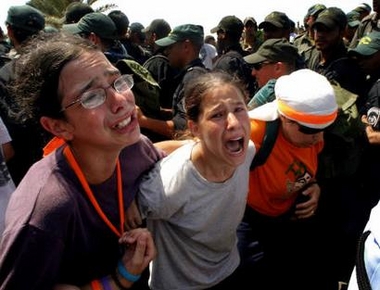
Allow me to share something personal with you.  Ever since the destruction of Gush Katif in 2005, I have been harboring a deep pain.  The images of Jews being forcibly dragged out of their homes - homes that they had lived in for 3 generations - is seared into my memory.  The knowledge that this trauma was inflicted by other Jews makes the thought almost too painful to bear.  And if this is what I feel - I who was safe and snug in my little home in Beit Shemesh - I cannot even begin to imagine what kind of pain is still in the hearts of the innocent people who were themselves expelled, betrayed and hung out to dry by their own nation.

Six years later, we have seen how the "Disengagement" plan, conceived in iniquity, legalized by duplicity, and executed with cold indifference, has backfired on us all.  I confess I don't know what the official statistics are, but given the fact that we are now absorbing continual rocket attacks from the ruins of Gush Katif, and that our standing in world opinion is far, far worse than it was prior to the expulsion, it's hard to believe that there is more than a tiny core of delusional, hard-core post-Zionists who still think it was a good idea.

OK, so now we've learned it was a bad idea, pragmatically speaking.  But frankly, that's not enough.  We screwed up - badly - and the people of Gush Katif paid the biggest price. And all we have done for them done to date by way of acknowledgement, effectively, has just been to say, "Oops...  Um... well, that didn't work out so well...  So sorry about that - and... um...  good luck with the rest of your lives!"  And we've merrily trotted off and started looking for fresh new ways to appease world opinion and try satisfy an enemy who will be happy with nothing less than our complete destruction.

Here's Repentance 101: Yom Kippur does not atone for sins between man and man, until the transgressor apologizes to the person he wronged and appeases him.  In these 6 years, we have done nothing of the sort for the Jews of Gush Katif.  If we have not achieved their forgiveness, how can we expect that Hashem will forgive us?  If we want G-d to forgive us for this terrible injustice that we perpetrated on our fellow Jews, and if we want to be able to pray for Him to relate to us with mercy - we had better be prepared to do teshuva for the cruelty we perpetrated on our brethren.

To this end, I have prepared the text of a collective, national apology.  Every one of us, to some extent, is responsible for what happened, as I have attempted to express in the text, and every Jew with a heart, anywhere in the world, should sign on, to say sorry.  I want 1 million signatures on this apology, and I believe this is attainable.

So, I ask you, please:
  1. Sign the petition here.  (Non-Hebrew speakers, please see the annotated screen shot here for what you need to fill in and click!)
  2. Spread the word.  Use Facebook, Twitter, your own blog, email, SMS, whatever.  For this to be a meaningful exercise, every Jew in the world, Right or Left, religious or not, needs to be able to say sorry to someone they wronged. 
Thank you for your help!  And in the merit of our national contrition, and hopefully the forgiveness of those we have wronged, may Hashem show mercy and forgiveness to us, and bring our final Redemption.

bit.ly/sorrygk

Tuesday, October 12, 2010

Down with the West!

The projections for Europe seem pretty bleak.  Aside from the suicidally low birth rates of "indigenous" Europeans, they have a surging Arab/Muslim population that is openly shaping to take over the continent altogether.  So apart from a few notable exceptions like Geert Wilders, the Eurowimps appear to have given up the game already, and are practising a mixture of appeasement and abject surrender to the conquering culture.  All the futurists concur that it won't be long before Europe is Eurabia - maybe a couple of decades and the whole continent will be under Sharia law.

The US isn't faring much better, either, under the Obama administration.  While I won't go along with the "Obama is a secret Muslim" conspiracy theorists, even though technically according to halacha nationality for non-Jews follows the paternal line (and his father was a Muslim), what is clear is that Obama shares the European penchant for craven multiculturalism, i.e. deprecation of Western culture, and reflexive respect, honor and awe for Islam.  That wouldn't be so bad if we could just wait him out for another 2 years, but he's also pursuing a radical socio-economic agenda, that if successful, will leave America's economy in ruins, like the European welfare states on which his policies are modeled.

You might choose to debate the intricacies of these arguments, and maybe I'm overstating the case, but the indisputable point is that the trend is a weakening, diffident and irresolute West, and a strengthening, confident and determined Islam.  Conventional wisdom is that this is, in general, a bad thing, because the kind of Islam that's on the rise is the kind that doesn't hold by our fancy modern liberal scruples, like women's rights, free speech, freedom of religion, gay rights, etc.  I, for one, would be very afraid of living in a Muslim state, and picturing the world under the domination of Islam is a frightening thought.

But maybe it's not all that bad.

I've been reading a fascinating little book by Rabbi Mordechai Neugroschel, whom I met a few months ago, called "Galus Yishmael", in which he suggests that there is more than just a little silver lining to this black cloud. There's a lot of research behind it from primary sources, but I'll try to precis the main ideas here, without quoting those sources:

There are many primary sources (e.g. gemara) and later commentators (e.g. Maharal) that refer to a Galus Yishmael, which is set to follow Galus Edom (our current exile), in which Esav (the West) hands over his power to Yishmael (the Arabs/Muslims), and the two combined proceed to oppress the Jews, with Yishmael now taking the lead role.  While the oppression of Galus Yishmael is in many ways more severe than Galus Edom that preceded it, it is a necessary step towards the ultimate redemption of the Jewish people.

The reason for this is really quite fascinating, and goes back to the story of Yaakov Avinu tricking Yitzchak into giving him the berachos instead of Esav.  The agitated Esav wheedles another set of blessings out of his father, among which: "...you will serve your brother, yet it shall be that when you are aggrieved, you may cast off his yoke from upon your neck." (Bereishis 27:40).  According to our tradition, this means that when the Jews are behaving correctly, keeping the Torah and all the mitzvos, then Esav is subservient and powerless against us... but the reverse is also true, that when we are not up to par, then Esav has the upper hand over us.  That's an ironclad promise from Yitzchak Avinu, and even Hashem will not nullify his words.

So how are we ever to escape from Galus Edom?  We cannot even rely on Hashem's mercy - Esav has a blessing from Yitzchak Avinu that gives him power over us, unless Klal Yisrael does mass teshuva!  What chance do we ever have of that?

No chance, so it seems.  And this is where Yishmael comes into play, as an unlikely - and unwitting - savior.  When Yishmael usurps world dominion from Esav, he also circumvents for us the problem of Yitzchak's bracha to Esav - because when Yishmael turns his malevolent attention towards the Jewish people, with Esav sidelined we suddenly have the ability to appeal to Hashem's mercy, even from our lowly spiritual state.  Yishmael has no blessing from Yitzchak, and therefore no guarantee of retaining the upper hand even when we are collectively sinful.  Indeed, the gemara tells us why he is called Yishmael - because in the end of days, the oppression from Yishmael will be so great that Yisrael will cry out to Hashem for help, and He will hear us (Yishma Kel).

So now it seems all along we've actually been cheering for the wrong team!  While Esav of late has certainly provided a more comfortable galus than what Yishmael is offering, in the long run it will actually be very good for the Jews for Esav to lose his world dominion to Yishmael!  I won't say I'm exactly rooting for Osama bin Laden & Co, because my enemy's enemy is, in this case, still my enemy.  But as a previous prime minister of Israel said in reference to some in-fighting between rival Arab groups: "I wish both sides the best of luck."

For us Jews, these ideas may serve as some comfort - and a reminder to us that our hearts should always be directed towards Heaven, because absent national repentance, only through our prayers and individual repentance can we be saved from our exile.  May we merit to see it speedily!

Monday, May 17, 2010

I am a Jew

This video is going viral, and it's not difficult to see why...

Sunday, August 2, 2009

Ayn Rand meets Rav Shimon Shkop

I just finished reading Ayn Rand's The Fountainhead. As a piece of fiction, I found it very entertaining and compelling; as a work of philosophy, I found it intriguing. For those who haven't read it, she expounds her philosophy of objectivism through her characters, who are pretty weird at times, but she makes her point well enough.

One of the main points of objectivism is that your ethics are supposed to be governed by rational self-interest. She is explicitly against altruism, that is, the sacrifice of self for others, but she equally does not subscribe to the converse, sacrifice of others for self. People should aspire to their highest potential, irrespective of others, and neither live for others nor expect others to live for them.

Seems a bit selfish and heartless, doesn't it?

I'm not so sure she's so far off the truth. My friend MG told me a vort he heard in the name of Rav Shimon Shkop. (I can't verify the quote; if anyone can give a source for this, I'd be most grateful.) He was asked, if Hashem wants us to do chesed with others, why did He make us naturally so selfish?

Rav Shkop answered that the selfishness that G-d gave man is part of the gift of being able to do chesed. If you have a normal, single person, he looks out for his own interests. He gets married, and now he also looks out for his wife's interests. he has children, and he now looks out for his children's interests. All the time he is being selfish - but he views his wife and children as an extension of himself. If a person works on his ahavas Yisroel, he will grow his concept of self until he sees all of Klal Yisroel as extensions of himself, and he will look out for their interests as he looks out for his own.

In other words, Judaism does not preach negation or sacrifice of the self; rather a person must develop a healthy sense of ego that encompasses the well being of others.

Ayn Rand almost got there, but in her vehemence against collectivism/dependence, she stopped short at libertarianism/independence and missed the final step: interdependence. (Stephen Covey fans, that's for you.) Interestingly, none of her characters ever have children. Nor did she. I guess that's what happens when you can't grow your ego past yourself.

EDIT: Thanks to MG, who saw this post and sent me links to Rav Schwab's magnum opus, Shaarei Yosher. The part about developing your ego to encompass others is in the introduction, pages 1 and 2.

Tuesday, June 23, 2009

The irony of having a "friend" in Washington

When George W Bush was running for re-election against John Kerry in 2004, I speculated with some of my friends that maybe it would be better for Kerry to win, because at least then you'd know who you're dealing with. With Bush, who was perceived as a "friend" of Israel, it'd be difficult to say "no" to any demands he places on Israel, even though you know the Palestinians will serially violate every single one of their obligations with impunity - because Bush is a friend, and we don't want to alienate our friends, right? But for Kerry, who is known to be more pro-Arab than Bush, there wouldn't be any illusions, and therefore no need to pander to him.

My friends swung me only on the basis that Bush was in favor of keeping US troops in Iraq, which is exactly where you want them if Iran was ever going to be subjected to the former Bush Doctrine of regime change for governments that support terrorism, while Kerry had promised a full pullout.

Four years later, I had the same debate, and still came out rooting for John McCain for the same reasons, muttering a quiet "baruch Dayan HaEmes" when the results showed Obama had won. And now we get to see my "friend in Washington" thesis in practice.

Obama has truly surpassed all my expectations for alienating Israelis. It really is amazing how he has swung Israeli public opinion since his inauguration: when he started out he had 31% of Israelis thinking he was pro-Israel, versus 14% who felt he was pro-Arab, and 40% felt he was neutral. The latest opinion polls have only 6% still thinking he's pro-Israel, 36% neutral, and fully 50% now feel he's pro-Arab. You gotta hand it to the guy - that is really amazing work. Not only has he debased himself by grovelling in front of the Muslim world with his cringing apologetics in Cairo, but he has succeeded in completely alienating Israelis to the extent that only 6% of us feel that he's on our side!

To me, this is very good news. He now has absolutely no leverage to extract any more stupid unliateral concessions out of us. Take today - the US State Department officially stated that they demand and end to all construction in Jerusalem suburbs on the "wrong" side of the Green Line, including "natural growth". Does anyone seriously believe that we're going to listen to a bombastic edict like that? Fuggedaboudit. Obama is just burning all his leverage with Israel, because no "friend" could make a demand like that, especially when we would be getting nothing in return. To a world of Islamist enemies, the USA has no concrete demands, just some touchy-feely stuff about trying to get to know each other better - but for Israel, the US's only staunch friend and ally - for Israel, the US knows how to make concrete demands.

And if we don't comply? What are they going to do - declare sanctions on us? Congress and Senate may be stacked with Democrats, but most of them are still pretty pro-Israel, to the extent that there's even been a rumbling among the Democrats themselves about Obama's Israel-unfriendly line. Sanctions not happening any time soon.

There really is great meaning to the "Baruch Dayan Haemes" blessing - we acknowledge G-d's greater judgment when things happen that appear to be bad. Obama's ascent to the presidency looks like really bad news, but I'll bet in the next 4 years Israel makes fewer stupid unilateral concessions than it did in any of the 4-year terms of Bush (Jr and Sr) or Clinton.

Wednesday, June 17, 2009

Rabbi Horowitz - The System Worked

After all the bad press we've been getting about the sexual molestation issues in our community, at last we have some good news from Rabbi Yakov Horowitz.

Note that in this case, they went straight to the police. Not to the tznius police, the real police. It was handled cleanly, discreetly, and with the full cooperation and support of the local Rabbonus.

Think we could manage that here?

Sunday, June 14, 2009

Girsa d'yankusa

Jewish tradition has a very strong emphasis on "girsa d'yankusa" - the things you learn when you're young. On a fresh, impressionable mind, things make a much greater impact - so it's considered really important to start out on the right foot.

I can see how true this is of myself. I grew up in a pretty liberal household in South Africa, and the things I learned under my parents' tutelage have been the things that have most stuck with me in my life. Things like basic menschkeit and honesty. Having an open mind, and encouraging questioning. A deep seated revulsion at racism of any sort - I will never forget the telling off I got when, as a 6-year-old, I repeated a racist term I had learned from my schoolmates! I also imbibed a culture of activism, and having the courage to stand up for what you believe in, especially from my mother, who was arrested several times for anti-apartheid activities. People who haven't lived in a fear society usually don't fully appreciate just what kind of mesirus nefesh it takes to be a dissident, and actively work against the regime. My parents took great risks to do what they believed was right, and I can only pray that I can be a worthy heir to this spirit.

I only became religious at age 20, long past my "girsa d'yankusa" stage. And while I have intellectually accepted the ol malchus shamayim, internalizing it to the degree that it is a part of my personality is much more of a struggle, particularly where my religion might conflict with some of the things I learned as a child. I instinctively look for accommodations, and it's a constant challenge for me to be conscious of where the accommodation is justified, and where it's just a case of cognitive dissonance.

For example, I learned to live and let live. If someone else wants to do something that you disapprove of, unless it materially affects you, you should leave him alone to make his own choices. Judaism, on the other hand, is pretty strong about coercion, to the point where (in the presence of an authorized court) a Jew who eats pork can be flogged to within an inch of his life, and he can be sentenced to death for driving his car on shabbos. If that's not coercion, I don't know what is. But here I am, openly criticizing the ban on pork sales, advocating for civil marriage legislation, and quite willing to give directions to a Jew who is driving his car on shabbos. In each one of these instances I have, I believe, sound halachic reasons to back up my position, whether because the benefit of the coercion is outweighed by the loss, or because by giving the guy directions you are actually minimizing the chillul shabbos. But my position is not mainstream; I venture you'd find that most religious Jews would reflexively take exactly the opposite position to me in all of the above issues.

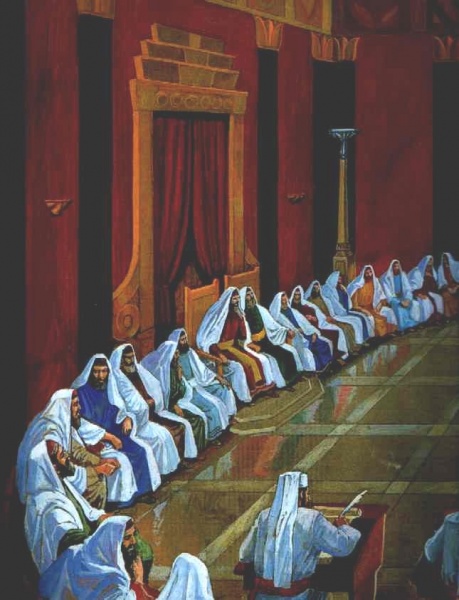
I was brought up with democracy as a fundamental value. People choose their leaders, and the leaders are answerable to their electorate, who will punish them if they fail to perform. Contrast Judaism, which on the face of things, does not have such a concept as leaders elected from the bottom up. The Jewish ideal is top-down: a king, appointed by Divine edict through a prophet, succeeded by his biological heirs, and wielding practically absolute power, albeit constrained by his own requirement to keep all the mitzvos of the Torah, as well as certain checks and balances that are under the control of the Sanhedrin. And the Sanhedrin itself is certainly not elected; it is appointed in much the same way (lehavdil elef havdolos) as the Israeli Supreme Court, only more so - there is not even a judicial selection committee for lay people to have their say; new dayanim on the Sanhedrin are appointed only by the existing members!

I reconcile this by saying that the Sanhedrin represented an unbroken chain of command from Moshe Rabbeinu and the 70 elders, who in turn appointed the best possible people to fill any vacancies. If you have a benevolent leadership like this, their judgment is probably way better than the judgment of a bunch of mostly ignorant lay people. After all, according to pure democratic principles, we have the absurd situation that a mentally retarded teenager's randomly chosen vote carries as much weight as the carefully considered position of a G-d fearing genius like Prof. Yisrael Aumann. But in our time, when we have no prophet to declare whom Hashem has chosen as king, and our Rabbinic chain of command has been all but broken, democracy is simply the best alternative we have left. We cannot continue to follow the paradigm of self-appointed, self-perpetuating structures, because look what happens if your original kernel is corrupt: you come out with an abomination like the Israeli Supreme Court, whose primary agenda appears to be stripping Israel of every last vestige of real Jewish values. We are therefore forced to fall back on the people's choice, both in terms of leadership and judiciary, because a leadership that is answerable to its people is far more likely to be benevolent than an unscrupulous dictatorship. (I include the judiciary in a guarded kind of way, because truthfully, we do have a Jewish judiciary even today - but there is no one beis din that is universally accepted by all factions, so unless all today's gedolei Torah can get together to appoint a Sanhedrin, a hypothetical Torah-true State of Israel would have no alternative but to have some kind of democratically appointed Sanhedrin, perhaps appointed by democratic vote among the gedolei hador.)

What about other clashes with Western values, such as "gender equality"? Yeah, yeah, I know all the apologetics about "separate but equal", and the different roles that men and women are supposed to play in Judaism. But am I happy to let my two sons split my entire inheritance, leaving my three daughters with nothing? Not a chance. Whatever the halachic devices are to do so, I fully intend to make sure that my daughters get their fair share of my estate. What is this? - do I think I'm smarter than the Torah? I'm uncomfortable with the dissonance between my professed beliefs and the fact that I simply don't want my inheritance to be distributed the way the Torah says it should be. Is that a bad thing?

I'm sure there are many other areas of my life where my worldview is colored by my secular/traditional upbringing, and is in conflict with authentic Jewish values - whatever those are.

What about you?
What was the "theme" of your upbringing?
How does that mesh with your current lifestyle?
What dissonances do you experience in your life?
What lessons have you learned, and what advice do you have for others to deal with dissonances?

Wednesday, June 10, 2009

The safest place for your life's savings?

With the world's financial crisis, many people have joked that the safest place for your money is under your mattress.

Well, apparently that's not necessarily so!

An Israeli woman mistakenly threw out a mattress with $1 million inside, setting off a frantic search through tons of garbage at a number of landfill sites.

The woman told Army Radio that she bought her elderly mother a new mattress as a surprise on Monday and threw out the old one, only to discover that her mother had hidden her life savings inside.

But look at what she has to say about this misfortune - a profound Jewish response:
For her part, Anat said it could be worse. "People have to take everything in proportion and thank God for the good and the bad," she said.
Kol hakavod, Anat! That is a kiddush Hashem. May He restore your mother's lost money!

Wednesday, May 27, 2009

Bad news proves: The world is great!

On the way to visit my wife in hospital a couple of weeks ago, I picked up a hitchhiker. On hearing that we had just had a son, my passenger commented, "It's so nice to hear good news, when the world is so full of difficulties and tragedy." He then proceeded to enumerate several instances of people he knew in difficult financial, health and family situations... being a kind-hearted Jew, he was clearly very touched and disturbed by the suffering of his fellows.

I thought about this for a minute, and started speculating aloud with him:

As human beings, we are drawn to read bad news. Newspapers are filled mostly with a mixture of alarming, depressing and outraging articles; clearly that's what people want to read! Why are we so perversely fascinated by bad news? Why are we more drawn to a story of a horrific car accident ר"ל than a story about a new medication that will lengthen and improve the lives of millions of cancer sufferers?

In determining newsworthiness, my guess is that the most eye-catching stories are the ones that are the most out of the ordinary. Dog bites man = yawn; man bites dog = wow! So in fact, the fact that the media reports on so much negativity is the exception that proves the rule: The world is great!

As you read these words, thousands of babies are being born all around the world, bringing joy and excitement to their parents. Nobody reports on this tremendous miracle, because it is so common, we have come to take it for granted. Yes, many people are dying, too - but mostly people who have lived a good and long life. Most people in the world have enough to eat; most people enjoy their lives in general. The sun rises and sets like clockwork, providing exactly enough light and warmth to sustain life on the planet; our climate patterns are stable enough that we can predict with great confidence whether we should pack away our winter woollies for the next 6 months. Electricity supply has over 99% uptime (compare that to 100 years ago!), we can make inexpensive or free phone calls all over the world, with streaming video, we have a zillion and one different flavors of ice cream (dairy and pareve) to choose from, and we have baby-soft, fresh disposable toilet paper (check out Shulchan Aruch Orach Chayim 3:11 for the alternative).

Yes, folks, the world is working just great, thank you. And instead of focusing ourselves on the exceptions to the rule and getting all depressed by them, we should continually marvel at and be grateful for the infinite kindness of the Creator, Who has set things up so staggeringly perfectly that we barely notice how good things are, except by exception. It's just as well some bad things happen; otherwise we might never notice the good...

Thursday, May 21, 2009

Azriel Chayim Behr

On Monday 18 May 2009, כ"ד אייר תשס"ט, our son entered into the Bris of Avraham Avinu, and was given the name Azriel Chayim - עזריאל חיים.

This is a first for us. For all our previous children we put a lot of thought into the meaning of their names, the etymology of each name, the balance between the first and second names, etc. etc. This time around it didn't really matter to us what the names Azriel or Chayim mean or how they complement each other, or even that "Azriel" sounds uncomfortably like our older son's name "Ezra", which could possibly giving the impression that we're obsessed with help (עזר being the root of both names)! There was almost no need for discussion; we simply knew, even from before he was conceived, that our next son would bear the name Azriel Chayim. Because that is the name of the person who, in my humblest opinion, was probably the greatest human being I have ever met.

That's him on the left: Rabbi Azriel Chaim Goldfein זצ"ל, the Rosh Yeshiva of the Yeshiva Gedola of Johannesburg, who passed away about a year and a half ago at the relatively young age of 73. I have written before about him, in a more oblique way; and many others have delivered spoken and written hespedim for him. I'd like to add my angle here.

Rabbi Goldfein was one of those rare individuals who was beloved by practically everyone he ever met. He loved and could relate to every human being, whether the greatest Torah scholar, an assimilated Jew or a non-Jewish nurse taking his blood pressure. He could converse freely and easily with anyone, with sincerity and interest, as one person said at his funeral, as if they were his best friend in the world. "Nay," said this speaker, "when he was talking to you, you were his best friend in the world."

He was a man of profound humility. He did not puff up in self-importance; he declined to grow a beard (other than during sefira and bein hameitzarim); while always dignified, he never felt the need to dress in an overtly "rabbinic" way. I heard that at one major public dinner, there was one table reserved for the Rabbis of the community. Rabbi Goldfein was among the first to arrive, and as he was making to sit down at this table, one of the waiters came and said, "Excuse me, sir, you can't sit here; this table is reserved for the Rabbis!" Rabbi Goldfein simply thanked the waiter for pointing this out, and politely moved away, mingled with other guests, and only later discreetly returned to the Rabbis' table along with his colleagues.

He drilled home the importance of derech eretz, how important it is to behave like a mensch, to dress like a mensch, to relate to others like a mensch. Derech eretz kadma laTorah, he always said: if you don't have the most basic level of menschkeit, how is it possible that the higher level of Torah is going to stick with you? Can you have a house without a foundation?

And speaking of Torah, he was a person who was, if you can have such a thing, the embodiment of pure, unadulterated Torah, with no add-ons of politics or other agendas. Once an Israeli professor met him, learned he was a Rosh Yeshiva, and asked him which camp he was from. "What do you mean, what camp am I from?" asked Rav Goldfein. "I'm a Rosh Yeshiva, not a Rosh Machaneh!" He had no interest in these political squabbles. All he wanted was to know the emes - how to understand the daf, what is the halacha; what does Hashem want us to do? And a love of Torah! He was generally a happy and optimistic person - but when he was giving shiur, he never stopped smiling - not for a minute! Even when he was in hospital, towards the end, in great pain and discomfort, and under strict instructions to relax and not strain himself, he could not resist engaging in Torah discussions with his colleagues and students who came to visit him. He would simply forget his pain, becoming more and more animated and excited as the discussions progressed, until the doctors would come and eject his guests and sternly warn him (again) that he needed to rest.

But to me, the one thing that he represented most strongly was balance. As I mentioned in my previous article, it's actually pretty easy to be stringent all the time. All you have to do is work on your gevura, your ability to restrain yourself, and you can say "no" to pretty much anything. But that's not the whole picture - because for every stringency there is an associated leniency. You want to make your restaurant "mehadrin"? If all restaurants do that, all the "regular" shochtim will lose their parnassa! You want a new, nicer mikveh, with more hiddurim? And cast aspersions on all the people who used the old mikveh for decades before? Every choice in life is something to be weighed up carefully, and casually choosing to err on the side of (apparent) stringency is not automatically the safest route!

Rabbi Goldfein to me represented the struggle for balance - and a thoroughly successful one at that. It is our beracha to our child, Azriel Chayim, that he should take after his namesake in all the aspects I have described above, and that his struggle for perfection throughout his life should be similarly blessed.