Showing posts with label philosophy. Show all posts

Tuesday, September 8, 2009

The worst form of evil - and how to fight it

As an optimist, I always like to preface negativity with some positivity. So let me start by saying there are a lot of really good people out there. People who love their fellow Jews. People whose observance and learnedness of Torah has brought them to the highest levels of perfection attainable by a human being.

And then there are some pretty nasty people out there. There are the Amalekite types - non-Jews who just hate Jews lishma. Then there are the Achav/Menashe types, also known as mumar l'hach'is (MLH) - real self-hating Jews whose share Amalek's goal of eradicating Judaism, if not the Jews themselves. And we have the more benign (and very common) mumar l'teiavon (MLT) - Jews who don't keep the Torah because it's inconvenient, they are unmotivated, they cannot control their desires, etc. Have I covered everyone?

Apparently not. There's another kind of baddie out there. This one is a talmid chacham. He is G-d fearing, pious, learned and scrupulously meticulous in his performance of mitzvos. He is passionate and fiercely committed to Yiddishkeit. And he is responsible for more death and destruction ר"ל to the Jewish People than any of the previous categories of sinners. Let's hear more about him from the Netziv, Rabbi Naftali Tzvi Yehuda Berlin, in this extract from his introduction to Sefer Bereishis from Ha'Amek Davar (translation mine):
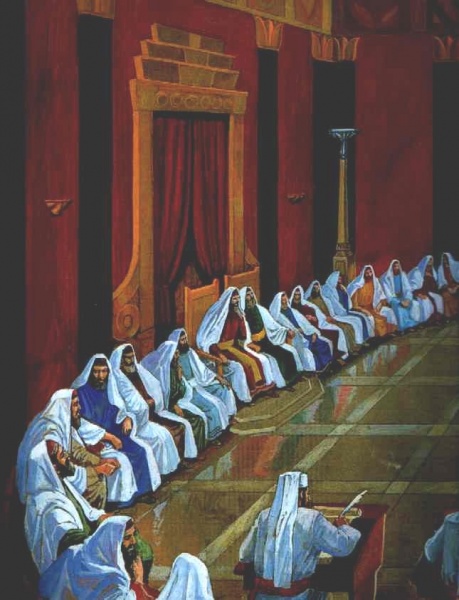
[The Jews at the time of the destruction of the Second Temple] were righteous, pious and labored in Torah. But they were not straight (ישרים) in their conduct. Therefore, because of the causeless hatred (sin'as chinam) for each other in their hearts, they suspected anyone who acted differently from their view of fearing G-d of being a Sadducee and an Apikoros. This led to extremes of bloodshed and the most terrible evils in the world until the Temple was destroyed... Hashem is straight and does not suffer "tzaddikim" such as these... even though their intentions may be for the sake of Heaven, [these "tzaddikim"] cause the destruction of Creation and demolition of settlement in the Land [of Israel].

Yup, this "tzaddik" is responsible for nothing less than the destruction of the Temple, and every pogrom, expulsion, massacre and holocaust that has followed. And worse than the MLT, worse than the MLH, he can never do teshuva; he can never repent. He cannot, because it is physically impossible; he has nothing to repent for - because in his own mind, he is right, and everybody else is wrong.
Do you know anybody like that? I do. I met him online yesterday morning - or at least, I met his blog, after he spammed me (and many others in the Jewish cyberworld, as a subsequent Google search told me). Go ahead and take a look - but be warned: have an antacid and/or a stiff drink at hand, because this site is liable to do something serious to your metabolism. Here it is.

Notice how this guy meets all the criteria of the Netziv. Firstly, with brazen chutzpah, he titles his blog "Authentic Judaism" - in one fell swoop relegating anyone who doesn't agree with every word he says to the status of "non-authentic" and therefore an apikoros. (That's not speculation, by the way - he says so explicitly.) And he doesn't just disagree on issues - he loudly and proudly proclaims his own visceral hatred towards anyone who disagrees with him. He ridicules and insults gedolei Torah in the most despicable terms. All this he does this under the veneer of "hating Hashem's enemies", which everyone agrees is a mitzva. But he makes the logical non sequitur of jumping from "I am for Hashem" (true) to "Anyone who disagrees with me is against Hashem" (false). The site is so crammed with half-truths and non sequiturs, that it doesn't even merit specific critique. It is self-evidently sheker of the darkest, most vindictive variety. This is the yetzer hara with a yarmulke. This is truly the Face of Evil.

So what's a healthy approach to people like this? My first reaction after visiting his site was a powerful urge to vomit. Having calmed down a bit, I find myself filled with a kind of morbid fascination at the psychosis that has possessed this yid - and an icy fear at having felt the heart of darkness, and realizing that there is a very large proportion of "frum" society that shares it.

How do we deal with it? What hope is there for Am Yisrael if this malignant tumor of sin'as chinam has become so deeply rooted in our people that hatred has now become a shita, and aveiros of the worst order are considered mitzvos? We see it frequently, and I don't think I need to enumerate all the ways in which this vile philosophy is manifesting - hameivin yavin.

My Rav quoted to me, "A little light dispels a lot of darkness." Well, we have a lot of darkness out there that needs dispelling. I'd like to say that especially coming up to Rosh Hashana, we should take very great care to love and respect our fellow Jews, especially the ones with whom we have disagreements - but I don't think that's enough. The sin'as chinam machine is working powerfully and grinding away at our society, and I am afraid it's a weak and feckless response just to turn the other cheek and talk about brotherly love. As Edmund Burke said: “The only thing necessary for the triumph of evil is for good men to do nothing.”

I think our society needs a bigger tikkun. How about this: get a bunch of banners printed for people to hang off their balconies: "V'ahavta l're'acha kamocha"; "All Jews welcome in our neighborhood!" etc. Offer a nice sign to be put up at the new mall in Ramat Beit Shemesh (or wherever) to the effect that everyone is welcome, and there will be a zero-tolerance policy towards intimidation and physical or verbal violence; perpetrators will be ejected, by the police if necessary.

What ideas do you have? How do you think we should relate to crackpots like "Rabbi Authentic"? How can we counteract their poison and make a real tikkun olam?

Sunday, August 2, 2009

Ayn Rand meets Rav Shimon Shkop

I just finished reading Ayn Rand's The Fountainhead. As a piece of fiction, I found it very entertaining and compelling; as a work of philosophy, I found it intriguing. For those who haven't read it, she expounds her philosophy of objectivism through her characters, who are pretty weird at times, but she makes her point well enough.

One of the main points of objectivism is that your ethics are supposed to be governed by rational self-interest. She is explicitly against altruism, that is, the sacrifice of self for others, but she equally does not subscribe to the converse, sacrifice of others for self. People should aspire to their highest potential, irrespective of others, and neither live for others nor expect others to live for them.

Seems a bit selfish and heartless, doesn't it?

I'm not so sure she's so far off the truth. My friend MG told me a vort he heard in the name of Rav Shimon Shkop. (I can't verify the quote; if anyone can give a source for this, I'd be most grateful.) He was asked, if Hashem wants us to do chesed with others, why did He make us naturally so selfish?

Rav Shkop answered that the selfishness that G-d gave man is part of the gift of being able to do chesed. If you have a normal, single person, he looks out for his own interests. He gets married, and now he also looks out for his wife's interests. he has children, and he now looks out for his children's interests. All the time he is being selfish - but he views his wife and children as an extension of himself. If a person works on his ahavas Yisroel, he will grow his concept of self until he sees all of Klal Yisroel as extensions of himself, and he will look out for their interests as he looks out for his own.

In other words, Judaism does not preach negation or sacrifice of the self; rather a person must develop a healthy sense of ego that encompasses the well being of others.

Ayn Rand almost got there, but in her vehemence against collectivism/dependence, she stopped short at libertarianism/independence and missed the final step: interdependence. (Stephen Covey fans, that's for you.) Interestingly, none of her characters ever have children. Nor did she. I guess that's what happens when you can't grow your ego past yourself.

EDIT: Thanks to MG, who saw this post and sent me links to Rav Schwab's magnum opus, Shaarei Yosher. The part about developing your ego to encompass others is in the introduction, pages 1 and 2.

Sunday, June 14, 2009

Girsa d'yankusa

Jewish tradition has a very strong emphasis on "girsa d'yankusa" - the things you learn when you're young. On a fresh, impressionable mind, things make a much greater impact - so it's considered really important to start out on the right foot.

I can see how true this is of myself. I grew up in a pretty liberal household in South Africa, and the things I learned under my parents' tutelage have been the things that have most stuck with me in my life. Things like basic menschkeit and honesty. Having an open mind, and encouraging questioning. A deep seated revulsion at racism of any sort - I will never forget the telling off I got when, as a 6-year-old, I repeated a racist term I had learned from my schoolmates! I also imbibed a culture of activism, and having the courage to stand up for what you believe in, especially from my mother, who was arrested several times for anti-apartheid activities. People who haven't lived in a fear society usually don't fully appreciate just what kind of mesirus nefesh it takes to be a dissident, and actively work against the regime. My parents took great risks to do what they believed was right, and I can only pray that I can be a worthy heir to this spirit.

I only became religious at age 20, long past my "girsa d'yankusa" stage. And while I have intellectually accepted the ol malchus shamayim, internalizing it to the degree that it is a part of my personality is much more of a struggle, particularly where my religion might conflict with some of the things I learned as a child. I instinctively look for accommodations, and it's a constant challenge for me to be conscious of where the accommodation is justified, and where it's just a case of cognitive dissonance.

For example, I learned to live and let live. If someone else wants to do something that you disapprove of, unless it materially affects you, you should leave him alone to make his own choices. Judaism, on the other hand, is pretty strong about coercion, to the point where (in the presence of an authorized court) a Jew who eats pork can be flogged to within an inch of his life, and he can be sentenced to death for driving his car on shabbos. If that's not coercion, I don't know what is. But here I am, openly criticizing the ban on pork sales, advocating for civil marriage legislation, and quite willing to give directions to a Jew who is driving his car on shabbos. In each one of these instances I have, I believe, sound halachic reasons to back up my position, whether because the benefit of the coercion is outweighed by the loss, or because by giving the guy directions you are actually minimizing the chillul shabbos. But my position is not mainstream; I venture you'd find that most religious Jews would reflexively take exactly the opposite position to me in all of the above issues.

I was brought up with democracy as a fundamental value. People choose their leaders, and the leaders are answerable to their electorate, who will punish them if they fail to perform. Contrast Judaism, which on the face of things, does not have such a concept as leaders elected from the bottom up. The Jewish ideal is top-down: a king, appointed by Divine edict through a prophet, succeeded by his biological heirs, and wielding practically absolute power, albeit constrained by his own requirement to keep all the mitzvos of the Torah, as well as certain checks and balances that are under the control of the Sanhedrin. And the Sanhedrin itself is certainly not elected; it is appointed in much the same way (lehavdil elef havdolos) as the Israeli Supreme Court, only more so - there is not even a judicial selection committee for lay people to have their say; new dayanim on the Sanhedrin are appointed only by the existing members!

I reconcile this by saying that the Sanhedrin represented an unbroken chain of command from Moshe Rabbeinu and the 70 elders, who in turn appointed the best possible people to fill any vacancies. If you have a benevolent leadership like this, their judgment is probably way better than the judgment of a bunch of mostly ignorant lay people. After all, according to pure democratic principles, we have the absurd situation that a mentally retarded teenager's randomly chosen vote carries as much weight as the carefully considered position of a G-d fearing genius like Prof. Yisrael Aumann. But in our time, when we have no prophet to declare whom Hashem has chosen as king, and our Rabbinic chain of command has been all but broken, democracy is simply the best alternative we have left. We cannot continue to follow the paradigm of self-appointed, self-perpetuating structures, because look what happens if your original kernel is corrupt: you come out with an abomination like the Israeli Supreme Court, whose primary agenda appears to be stripping Israel of every last vestige of real Jewish values. We are therefore forced to fall back on the people's choice, both in terms of leadership and judiciary, because a leadership that is answerable to its people is far more likely to be benevolent than an unscrupulous dictatorship. (I include the judiciary in a guarded kind of way, because truthfully, we do have a Jewish judiciary even today - but there is no one beis din that is universally accepted by all factions, so unless all today's gedolei Torah can get together to appoint a Sanhedrin, a hypothetical Torah-true State of Israel would have no alternative but to have some kind of democratically appointed Sanhedrin, perhaps appointed by democratic vote among the gedolei hador.)

What about other clashes with Western values, such as "gender equality"? Yeah, yeah, I know all the apologetics about "separate but equal", and the different roles that men and women are supposed to play in Judaism. But am I happy to let my two sons split my entire inheritance, leaving my three daughters with nothing? Not a chance. Whatever the halachic devices are to do so, I fully intend to make sure that my daughters get their fair share of my estate. What is this? - do I think I'm smarter than the Torah? I'm uncomfortable with the dissonance between my professed beliefs and the fact that I simply don't want my inheritance to be distributed the way the Torah says it should be. Is that a bad thing?

I'm sure there are many other areas of my life where my worldview is colored by my secular/traditional upbringing, and is in conflict with authentic Jewish values - whatever those are.

What about you?
What was the "theme" of your upbringing?
How does that mesh with your current lifestyle?
What dissonances do you experience in your life?
What lessons have you learned, and what advice do you have for others to deal with dissonances?

Wednesday, June 10, 2009

The safest place for your life's savings?

With the world's financial crisis, many people have joked that the safest place for your money is under your mattress.

Well, apparently that's not necessarily so!

An Israeli woman mistakenly threw out a mattress with $1 million inside, setting off a frantic search through tons of garbage at a number of landfill sites.

The woman told Army Radio that she bought her elderly mother a new mattress as a surprise on Monday and threw out the old one, only to discover that her mother had hidden her life savings inside.

But look at what she has to say about this misfortune - a profound Jewish response:
For her part, Anat said it could be worse. "People have to take everything in proportion and thank God for the good and the bad," she said.
Kol hakavod, Anat! That is a kiddush Hashem. May He restore your mother's lost money!

Tuesday, June 2, 2009

Spin

Here's a short video clip called "Spin", which I think carries some very deep and profound messages. Watch it and tell me what you think...


Hattip: Mois

Wednesday, May 27, 2009

Bad news proves: The world is great!

On the way to visit my wife in hospital a couple of weeks ago, I picked up a hitchhiker. On hearing that we had just had a son, my passenger commented, "It's so nice to hear good news, when the world is so full of difficulties and tragedy." He then proceeded to enumerate several instances of people he knew in difficult financial, health and family situations... being a kind-hearted Jew, he was clearly very touched and disturbed by the suffering of his fellows.

I thought about this for a minute, and started speculating aloud with him:

As human beings, we are drawn to read bad news. Newspapers are filled mostly with a mixture of alarming, depressing and outraging articles; clearly that's what people want to read! Why are we so perversely fascinated by bad news? Why are we more drawn to a story of a horrific car accident ר"ל than a story about a new medication that will lengthen and improve the lives of millions of cancer sufferers?

In determining newsworthiness, my guess is that the most eye-catching stories are the ones that are the most out of the ordinary. Dog bites man = yawn; man bites dog = wow! So in fact, the fact that the media reports on so much negativity is the exception that proves the rule: The world is great!

As you read these words, thousands of babies are being born all around the world, bringing joy and excitement to their parents. Nobody reports on this tremendous miracle, because it is so common, we have come to take it for granted. Yes, many people are dying, too - but mostly people who have lived a good and long life. Most people in the world have enough to eat; most people enjoy their lives in general. The sun rises and sets like clockwork, providing exactly enough light and warmth to sustain life on the planet; our climate patterns are stable enough that we can predict with great confidence whether we should pack away our winter woollies for the next 6 months. Electricity supply has over 99% uptime (compare that to 100 years ago!), we can make inexpensive or free phone calls all over the world, with streaming video, we have a zillion and one different flavors of ice cream (dairy and pareve) to choose from, and we have baby-soft, fresh disposable toilet paper (check out Shulchan Aruch Orach Chayim 3:11 for the alternative).

Yes, folks, the world is working just great, thank you. And instead of focusing ourselves on the exceptions to the rule and getting all depressed by them, we should continually marvel at and be grateful for the infinite kindness of the Creator, Who has set things up so staggeringly perfectly that we barely notice how good things are, except by exception. It's just as well some bad things happen; otherwise we might never notice the good...